Mirogoj --- A Meditative Exercise
Nature does not ever cease to amaze me. It holds me in its magical embrace as I gaze at a star-studded sky, ponder over the seasons that never fail to change when it’s their time to come on, or bask in the warmth of the autumnal hues that leave me eternally entranced. I rue that I am no poet to do justice to what I behold, to what the Divine Author has created.
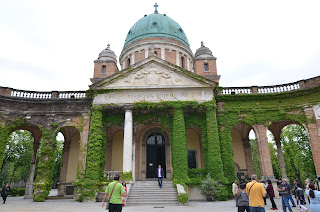
And here, as I stand before Mirogoj, a man-made architectural splendour on the slopes of the Medvednica Mountain in Zagreb, the Croatian capital, I am overwhelmed by the same sense of awe. The eternal romantic in me compels me to scribble what the lens of my eyes capture, the sights that make my heart flutter and take a leap. My head, the brain’s grey cells, the mind, the senses, perhaps it's all of them - they witness an onslaught of thoughts that come rushing like waves unstoppable, begging me to weave a tale. Even a myriad tales ….

A place of quiet contemplation, the wooded area, serene and sombre, compels me to ‘introsphlect’ into the transient nature of mortals and worldly glory. As the country’s outstanding and obscure rub shoulders in the cold confines of the bowels of the earth, I am apt to ponder on death, the leveller. Having run various life races they lie there spent, making good their escape from the pandemonium and perils of pedestrian life.

I feel no sadness here, in this sprawl dedicated to the departed; rather, a melancholic mood morphs into meditative mode in this cemetery. One of Zagreb's most scenic landmarks located in the outskirts of the city, Mirogoj is an open air museum, a veritable gallery of Croatian history, art, architecture and aesthetics spread over 7 acres, swathed in verdure.

For the taphophile or tombstone tourist, it is one of Europe’s most beautiful cemeteries, a majestic expression of architectural eloquence. It is replete with a score green oxidized copper domes, fiesta of cupolas, 77 large and 69 small tiled arcades that seemingly stretch into eternity, lavish cloisters, pavilions chapels and tombs. Its magnificent domes, reminiscent of a cathedral, boast lavish interiors in pastel hues while the wee windows skirting their rim, allow light to liltingly illuminate the painted embellishments. Considered the biggest achievement of Croatian sepulcher architecture, Zagreb’s largest memorial garden is lush with a cornucopia of giant trees, foliaceous plants and creeping ivy that is everywhere.

Designed by Austrian architect Hermann Bolle, its construction which was begun in 1879, took final shape in 1929. The main cemetery church with a large copper-green dome greets us at the main entrance. Mirogoj magically unfolds itself at its very entrance which is interwoven with climbing plants and resembles a fortress of monumental proportions. Its beauty is further enhanced by clear perspectives, symmetry and right division of lights and shadows. History whispers from every corner of its mammoth stone walls as we walk its length and breadth, lined by avenues of chestnut, maple, spruce and lime trees. Delicate and intricately sculpted figures of all sizes adorn many of the tombstones that lie in a perfectly aligned grid formation.

Over 300,000 souls lie buried in Mirogoj which boasts giant statues of Moses with Hebrew inscriptions, simple Islamic tombs with stunning Arabic calligraphy, ornamental sculpted statuettes of Christian saints, and simple graves, all of which create a unique sense of harmony. Bang behind the main church lies the tomb of independent Croatia’s first president, Franjo Tudman. It is a distinctively immense black granite square structure upon which rests a gently sloping triangle with Tudman’s name etched in gold. As most visitors do, we too halt at the memorial to Drazen Petrovic, the Croatian basketball player who died at the very young age of 28 in an automobile accident, who took his team to the 1992 Olympic finals. There are a couple of memorials to victims of the First World War as also a monument dedicated to some victims of a plane crash at Zagreb in September 1976, and the country’s worst ever aviation disaster which saw no survivors. A wide array of sculptures, from figurines of Christ to objects sported by the deceased, or related to their profession, are depicted in some of the tombs and niches in the arcades.

Mirogoj, the garden of remembrance was officially opened on November 6th, 1876 with the first funeral held just a day later - that of the fencing instructor and gym teacher Miroslav Singer, a well-respected man. Croatians remember the deceased on All Souls' Day, November 2. The day is phenomenal at Mirogoj with thousands of candles being lit and plethora of wreaths bedecking the graves. The nation’s officials also pay homage to those who laid down their lives fighting Croatia’s War of Independence.
As peace and tranquillity predominates in its portals despite a steady flow of tourists, Mirogoj urges one to contemplate on the vicissitudes of life, awakens us to its frailties, prompting us to reflect and go inwards to decipher the path we tread, to unravel our very being and the purpose for which we have taken this birth.
*****
Comments
Post a Comment